P1.T4.PQ Measures of financial risk Dowd -ES

FRMCAND

Member
Hi David,
Concerning PQ 29.1 VaR Coherent risk measure ,I do not understand the reasoning about Prob of zero default=[95%^3].Is alpha considered as the prob that the bond will not default?
Given the PD bond, I'm tempted to measure the prob of no default as [1-PD].
Thank you very much four your help.

PS.i make mistake in the thread name.i mean VaR,not ES...I'm unable to modify it.sorry
 
Hi FRMCAND,

Here is the source, with discussion http://forum.bionicturtle.com/threa...alue-at-risk-var-coherent-risk-measures.5690/
i.e., I show Prob [zero defaults] = 97%^3.

You are, of course, correct that prob [no default among n | i.i.d.] = (1-PD)^n, but as, in this question, PD = 3%, we can define (as Saunders does) p = prob of repayment = 1 - PD, such that Prob[no default | i.i.d.] = (1-PD)^n = p^n.

The PD & p inform the ultimate binomial distribution, right? VaR is another matter, it returns a property of that distribution (quantile). Dowd uses alpha (α) = significance, such that 1 - α = confidence, and he happens to call that p, so he uses 1 - α = p. For example, a 95% VaR --> 1 - 5% = 95% confidence, so his p = 95%. But that is not to be confused with 1-PD.
(another example of how formula memorization can make this worse. All of these are just symbols)

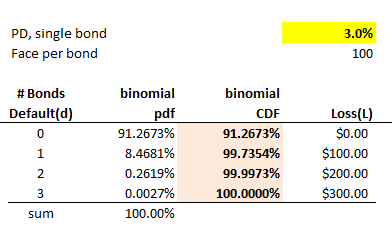
I think my XLS in the source thread shows it nicely, if i do say so myself ;) :
1114_P1T4_29_var.png


I love this for its illustration of VaR's lack of subadditivity, which i stole from Dowd of course. Maybe consider this in two steps, in order to emphasize the difference between the distribution and VaR (which retrieves a property of the distribution):
  1. PD (aka, EDF) = 3%, so we could say prob that all three bonds repay = (1-pd)^3 = p3 = 97%^3 = 91.2673%. Similarly, prob that all 3 default = 3%^3 = .0027%).
  2. VaR is then an arbitrary (user design decision) as to what confidence level (= 1 - significance level) we prefer to select. We can retrieve the 95%/5% VaR; we could retrieve the 97%/3% VaR, in which case the 3% is merely coincident. I hope that helps,
 
FRMCAND I see we didn't catch the correction in the PDF; i.e., the PDF explain incorrectly has "the probability of zero defaults = 95%^3 = 91.26%"
... which should be "the probability of zero defaults = 97%^3 = 91.26%. We need to fix that, sorry I see your confusion now. cc Suzanne Evans
 
Hi David,
exactly I was working on PDF file. I apologize for submit you a question already existing, but I did not found path as in the pdf.
In any case, I really appreciate your complementary explanation, for a better understanding of VaR's subadditivity violation.
Thank you very much.
 
Top