Professor Jorion, chapter 7

jcjc0602

Member
Hi everybody,

I am confused about a concept in chapter 7 of Jorion. In study notes (topic 52, 2012 edition), there is a sentence "both a correlation of zero and one will place a lower and upper bound on the portfolio total VaR". I can understand one will act as upper bound. How about -1, which I think will be lower bound instead of zero? Thanks!
 
VaR1-VaR2<sqrt(VaR1^2+VaR2^2)
(VaR1-VaR2)^2<(VaR1^2+VaR2^2)
VaR1^2+VaR2^2-2*VaR1*VaR2<VaR1^2+VaR2^2
-2*VaR1*VaR2<0 given that VaR1,VaR2>0
so its true that VaR1-VaR2<sqrt(VaR1^2+VaR2^2)
or that VaRp(rho=-1)<VaRp(rho=0).
the sentence should not be a general one but the author wants to highlight a case that correlation of zero provides lower limit and corr. of 1 will provide a upper limit to portfolio VaR.

thanks
 
Interesting. I do not agree with (and am not aware where Jorion says) that zero correlation is a lower bound (in the two-asset mean variance VaR).

The general form is VaR(P) = SQRT[VaR(1)^2 + VaR(2)^2 + 2*VaR(1)*VaR(2)*correlation]
  • VaR(1)^2 and VaR(2)^2 are always positive (increasing portfolio VaR),
  • The directional impact on Portfolio VaR therefore depends on the third term: +2*VaR(1)*VaR(2)*correlation
    • Where the product of weights is positive (e.g., long + long, short + short), lower correlation lowers portfolio VaR with -1.0 as lower bound
    • Where the product of weights is negative (e.g., long + short, higher correlation decreases portfolio VaR with +1.0 as lower bound on portfolio VaR
  • In this way
    • In a (typical) long + long portfolio, bounds are correlation -1.0 (lower) and +1.0 (upper)
    • In a hedged portfolio, long + short, bounds are correlation +1.0 (lower) and -1.0 (upper); i.e., i don't see where 0 rho is ever a bound.

      In the formula, this is because the short position has negative VaR(2) owing to its negative weight.
Jorion's interesting point (p 165, Chap 7) is, i think, that the hedged portfolio is counter-intuitive. Mathematically, again, it's because the short is represented by a negative weight.

I tested this in our XLS, see https://www.dropbox.com/s/2islu84rn567e69/0827_correlations.xlsx

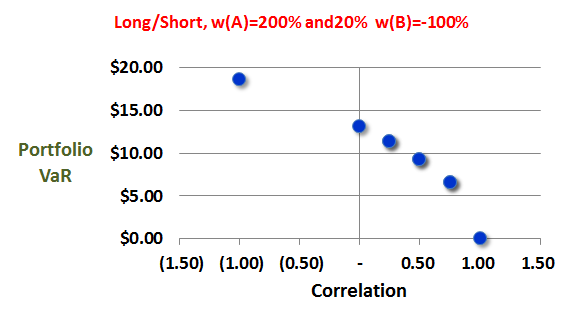
And here is the chart. This plots 99% 2-asset (mean-variance) portfolio VaR when:
  • 200% weight in Asset (A) with vol = 10%,
  • -100% weight in Asset (B) with vol 20%; i.e., long/short 200/100.
  • Note: perfect hedge occurs at correlation = +1.0
0827_correlations.png
 
Pg 18 of the study note refers to example on Jorion's 2 currency portfolio. Tha variance of the portilio is mentioned as 0.00271, however i am getting as 0.00269. Can you confirm the accuracy of the calculation? Also Pg. 19 shows the Dollar Variance as $24,400, i want to know how is this derived?
 
Hi Ruchir,

Your 0.00269 appears uses rounded weights of 0.67 and 0.33, which are more precisely 2/3 and 1/3 (e.g., 0.66667). The exact variance is given by:
(2000/3000)^2*5%^2 + (1000/3000)^2*12%^2 + (2000/3000)*(1000/3000)*5%*12%*0 = 0.0027111...

Dollar variance = 0.0027111 * 3,000^2, or maybe more intuitively = 2,000^2*5%^2 + 1,000^2*12%^2 + 0 = $24,400; i.e., dollar weights rather than percentages
Dollar variance can be used to compute beta (Jorion's beta after 7.19, page 167):
Beta = W * Dollar Covariance (i,P) / Dollar Variance(P)

Here is the underlying XLS, which includes the variants of beta/marginal VaR that depend on "dollar variance" and "dollar covariance:"
http://www.bionicturtle.com/how-to/spreadsheet/2011.t8.b.2.-jorion-analytical-var/
 
hi @David Harper CFA FRM CIPM on Jorion Chapter 7 notes, page 13, on calculation of variance of P using matrix notation, I am not getting the answer of 0.24 under the first example of assets I &J.
Appreciate if you can look into this.
Regards,
Sun
 
Hi @David Harper CFA FRM - I am having the same issue as I get 0.3987 instead of both matrix algebra and the formula for calculating the variance of a 2 asset portfolio. I have attached my calculations. Have I made a mistake or overlooked something?

Many Thanks,

Stephen
 

Attachments

  • Jorion Chapter 7 page 13.docx
    13.7 KB · Views: 6
Hi @stephenjohn Yes, I apologize: it is a mistake in the calculation, see previous comment here at https://forum.bionicturtle.com/thre...ormula-for-2-asset-question.10481/#post-50339 (snippet below)
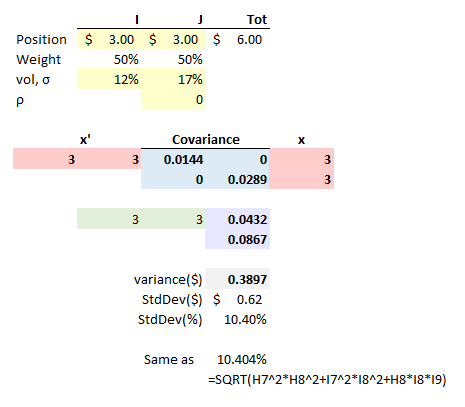
... further, my fresh calculation is exactly the same as yours (=0.0432×3+0.0867×3=0.3897), see XLS at https://www.dropbox.com/s/osftut2k9vdozbf/0517-t8-jorion-matrix.xlsx?dl=0
@kevolution I apologize but our matrix math is incorrect here. Of course you are correct the two methods should produce the same result: after all, your formula is the reduced version of the matrix approach for the special case of only two assets. I do agree with your result, the portfolio variance (in returns^2) should be 0.01083. I'm not sure how we mistakenly got 0.04 in the matrix math. Our mistake in σ^2(p) = x'*cov()*x is that you have to post-multiply then pre-multiply. I entered into Excel super quickly here at https://www.dropbox.com/s/osftut2k9vdozbf/0517-t8-jorion-matrix.xlsx?dl=0 See below, the first step (1. post multiply) returns the column vector in purple [0.0432, 0.0867]; then (step 2) the pre-multiply returns dollar variance of 0.3897, which matches return (%) StdDev of 10.40% such that 10.404%^2 = 0.0108. Thank you. cc @Nicole Seaman
0517-jorion-matrix.png

Please note that Deepa is currently revising this Jorion note (all four P2 Jorion notes, in fact) with much improvement, and this will be fixed in a better P2.R77 Study Note to be published ASAP. Thanks!
 
Top