
Optimal Unwinding of Positions

IDosh1374

Member
Subscriber
In the study note there is a formula for optimal unwind of position on page 8 (reading 66) screenshot attached.

My question is
1.What does the lamda and V stand for in these formulae, in GARP curriculum i cannot see these parameter
2. Sumation q = V what is this formula; can you give example on how to apply this?
3. Is this formulae tested in exam?
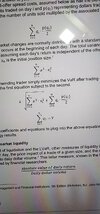
 
In the study note there is a formula for optimal unwind of position on page 8 (reading 66) screenshot attached.

My question is
1.What does the lamda and V stand for in these formulae, in GARP curriculum i cannot see these parameter
2. Sumation q = V what is this formula; can you give example on how to apply this?
3. Is this formulae tested in exam?
 

Attachments

  • 20250525_115927.jpg
    20250525_115927.jpg
    158.8 KB · Views: 3
@IDosh1374 1. V = your total position to liquidate, λ lambda is the Lagrange multiplier that enforces your “sell it all” constraint in the optimization.

2. It’s your budget constraint: across your n trading days, the sum of the daily sell‐orders q1+q2+⋯+qn must equal the full position V.

Suppose you hold $1 million of a stock and plan to unwind over 3 days. Let q1, q2, q3 be the dollar amount you sell each day. The constraint q1 + q2 + q3 = $1M ensures you liquidate the entire $1 million. You’d then solve the Lagrangian.

3. The GARP curriculum introduces the concept of L-VaR and the idea that you can optimize a trade schedule, but it doesn’t require you to set up and solve the Lagrangian in detail. Therefore, I think it is very unlikely that you will see an exam question. You might, however, see conceptual questions (“Why would you trade slowly to reduce impact?”), but not a full blown multiplier‐based derivation.
 
Top