Hull, Options, Futures, and Other Derivatives, Chapter 25

Vicky26

New Member
Subscriber
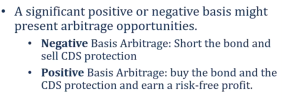
I dont understand this logic. If CDS spread>bond yield, then how is buy bond and buy CDS better. If CDS pread is 170bps and bond yield = 120bps, then net earn = Rf -50bps. So final earning is less than Rf.

1782479054632.png
 
Hi Vicky, Thanks for pointing this out. First, let's define the "basis":

Basis = CDS Spread − Bond Yield Spread (over Rf)

A positive basis means CDS spread > bond yield spread (your example: 170 bps − 120 bps = +50 bps basis)

A negative basis means CDS spread < bond yield spread

Now let's think through the arbitrage logic from scratch:

When the basis is negative (bond yield spread > CDS spread), say bond yield = 200 bps and CDS = 150 bps:
  1. Buy the bond - earn Rf + 200 bps
  2. Buy CDS protection - pay 150 bps
  3. Net = Rf + 50 bps — profit above the risk-free rate with no credit risk

When the basis is positive (CDS spread > bond yield spread), your example — CDS = 170 bps, bond yield = 120 bps:
  1. Short the bond - avoid paying the 120 bps spread; invest proceeds at Rf
  2. Sell CDS protection - collect 170 bps
  3. Net = Rf + 50 bps — again, profit above the risk-free rate

@nicole.seaman.cerifi I need to change this slide to the correct mapping:
  1. Negative (bond yield > CDS) - Buy bond + Buy CDS protection
  2. Positive (CDS > bond yield) - Short bond + Sell CDS protection
I apologize for the confusion this caused.
 
Last edited:
Top