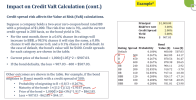
for BBB to B calculation for PV is at t=1month which is compared with current price which is at t=0. Shouldn't the time frame be same for loss calculation ?
Good question, and it gets at something students often trip over in this example. The time frames are actually intentionally different, and that difference is what defines the loss.
Think about what Credit VaR is measuring: you hold the bond today (t=0) at a known price, and you want to know what it might be worth one month from now under various credit migration scenarios. The loss is the difference between those two values. So the current price at t=0 is your starting point, and the bond values calculated at t=1 month are your possible ending points. You subtract to get the potential gain or loss over the horizon. It would not make sense to discount the "current" price forward or to recalculate a t=0 value for the migrated state, because the whole point is to measure how much wealth you could lose over the coming month.
The reason the BBB-to-B price uses a remaining maturity of roughly 1.917 years (instead of the original 2 years) is simply that one month of time has passed. After migration, the bond still exists but now has 23 months left, and it is being priced using the new B-rated yield (risk-free rate plus the B credit spread). That forward price reflects what the market would pay for that bond one month from now given the downgrade. The loss of $44.17 is the erosion in value you suffered by holding a bond that started as BB and ended the month as B.
So to answer your question: the time frames are not mismatched, they are deliberately set up as "what I have now" versus "what I will have at the end of the risk horizon." That gap is the loss you are trying to quantify with Credit VaR.
This site uses cookies to help personalise content, tailor your experience and to keep you logged in if you register.
By continuing to use this site, you are consenting to our use of cookies.