
Credit Risk Reading 10, Hull Chapter 19 CreditMetrics

Tracy M. Nolte

New Member
Subscriber
When walking through Reading 10 (Hull Chapter 19) in the Credit Risk book today, the BT associated slide deck has the following 2 tables with explanatory text on slides 18 and 19. The slides appear to discuss the same concept from CreditMetrics in depicting transition probabilities for 1 year.

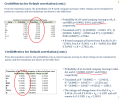
I included an image below to highlight that when referring to the B-rated company transition the text refers to cumulative probability whereas for the A-rated company transition the text appears to refer to the single probability.

I understand the focus in this section seems to culminate in using the normative cutoff as the indicator of the probability of a change in rating, but want to make sure that I'm not missing something in the text where I should consider this change over a single year as a cumulative probability?
1772390297167.png
 
When walking through Reading 10 (Hull Chapter 19) in the Credit Risk book today, the BT associated slide deck has the following 2 tables with explanatory text on slides 18 and 19. The slides appear to discuss the same concept from CreditMetrics in depicting transition probabilities for 1 year.

I included an image below to highlight that when referring to the B-rated company transition the text refers to cumulative probability whereas for the A-rated company transition the text appears to refer to the single probability.

I understand the focus in this section seems to culminate in using the normative cutoff as the indicator of the probability of a change in rating, but want to make sure that I'm not missing something in the text where I should consider this change over a single year as a cumulative probability?

View attachment 4882
@Tracy M. Nolte Good question. CreditMetrics always uses cumulative probabilities when mapping to normal cutoffs. What you’re noticing is not a conceptual change I just was a little inconsistent on my wording.

To map transition probabilities into the standard normal framework, CreditMetrics does the following:
  1. Start with one-year transition probabilities (single-year, marginal probabilities from the matrix).
  2. Convert them into cumulative probabilities across ordered ratings.
  3. Apply N−1(⋅) to those cumulative probabilities to obtain normal cutoffs.
The normal distribution requires cumulative probabilities because you are defining interval boundaries on a latent asset return distribution.

For the B-rated example the second step is cumulative. So we are building the boundary for the AA-to-A transition.

On the A-rated slide that is already the cumulative probability of moving to AAA (since AAA is the first rating category). then we move to N−1(0.0003+0.0167) which is again cumulative. So conceptually, nothing changes I just did not use the word cumulative on the second one.

so in short there is no conceptual shift between the two slides. Both are using cumulative probabilities to determine normal cutoffs.
 
Top