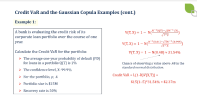
Vasicek model gives WCDR which is same as 1-V(T,X). Then why are we using V(T,X) while calculating Credit VAR. Formula for credit VAR should be L(1-RR)(1-V(T,X)) rather than L(1-RR)V(T,X). Is there any typo in this or previous slide ?
Vasicek model gives WCDR which is same as 1-V(T,X). Then why are we using V(T,X) while calculating Credit VAR. Formula for credit VAR should be L(1-RR)(1-V(T,X)) rather than L(1-RR)V(T,X). Is there any typo in this or previous slide ?
@Vicky26 The thing to remember is that V(T, X) in Hull's notation is already the WCDR. It is not 1 minus something, it is the worst-case default rate itself at confidence level X. So Credit VaR = L(1-RR) x V(T,X) is just saying worst-case loss = exposure x LGD x worst-case default rate. Totally straightforward once you see it that way.
The confusion usually comes from working through the Vasicek derivation, where you get:
@Vicky26 The key thing to remember is that V(T,X) in Hull's notation is already the WCDR. It is not 1 minus something, it is the worst-case default rate itself at confidence level X. So Credit VaR = L(1-RR) x V(T,X) is just saying worst-case loss = exposure x LGD x worst-case default rate. Pretty straightforward once you see it that way.
The confusion usually comes from working through the Vasicek derivation, where you get:
That whole expression is V(T,X). It spits out a high default rate at high confidence levels, so no extra "1 minus" step is needed.
If you used L(1-RR)(1 - V(T,X)) instead, you would be calculating the best-case loss, which is the opposite of what you want.
This site uses cookies to help personalise content, tailor your experience and to keep you logged in if you register.
By continuing to use this site, you are consenting to our use of cookies.